Dogs are Good People

Cabin July 2014 222I buried Caesar a few days ago.  He had been in the freezer until a purchase of Costco chicken displaced his temporary resting spot.   Caesar was a West Highland Terrier who had wandered onto our ‘estate’ a couple of days after this recent Christmas.

When I first saw him, he was wearing a red collar which contrasted nicely with his dirty white fur and he was nonplussed by my two rather rambunctious dogs.  Ambling around somewhat aimlessly, I had assumed he was a pet of a holiday visitor in the neighborhood.  But he kept circling back to where I was weeding and I noticed his collar had no identification.  His plodding gait conveyed lost and weary.  His dingy hair seemed indicative of abandonment.

At this point, I should point out that I am a sucker for wayward animals.  As kids, my siblings and I were never allowed pets.  Withholding water from a person does not decrease their thirst and I suspect the absence of dogs in my young orbit only added to my affection for them.  I came to agree with the opinion of an old time nurseryman I once knew who told me, “I don’t trust anyone who doesn’t like dogs and children.”

But back to the story at hand . . .

In the ensuing days, my daughter named our stray Caesar.  His wobbly trot and aloof demeanor described him as an older gentleman.  I took him to the vet to have him checked out.  A scan proved he had no identification chip and the kindly attendant told me that he (the dog) had ‘found’ me.   She verified our thoughts that he was near the end of his life and likely wouldn’t be around too much longer.  I left with a supply of antibiotics and pain meds for the old fella and then got an appointment with a dog groomer.

Cabin July 2014 225By the time he was deposited at the stylist he had been in my possession only a brief while and we had never heard him speak.   Yet when I went to pick him up, he recognized me from a distance and, to my surprise, barked with recognition and a voice that said “Get me outta here!”  As a gesture of his appreciation, he peed on some nearby grass before I loaded him in the truck.  Although I didn’t mimic his action, as males it was clear we had bonded.

Despite efforts to locate his owner, none was found, and Caesar gradually melded into our household.  With an infrequent hobby horse run, those brief occasions would be an indication of his younger days.  But most often he slept a lot and had difficulty going up and down the two steps that define our kitchen entry.  Although house broken, he made little effort to get much past the side door to take care of business.  However, his senses did not fail him in receiving tidbits I fed him from the dinner table.  Perhaps this is why almost every dog that I have known will rest at my feet while I eat.  I am regularly chastised for my hillbilly behavior but I have yet to have any of the dogs object.

Over the years, we’ve had many associations with pets of all sorts including a number of cats and dogs.  Each claimed a part of our hearts and their respective departures from this world were painful.  For those who have lived with them, it is understood that dogs are very disparate characters but almost always unconditionally loving.  (Remember that it’s the proverbial cat that one kicks after a bad day.)  The family dog is just too endearing to receive abuse. Note to reader: Just so I don’t get a lot of “hate mail”, that is written tongue-in-cheek as this article is focused on dogs!

So, Caesar, you are resting in fine company with the other animals (all good people) that have also lived in our hearts and home.  I believe you continue to enjoy the place you chose to be.

We’ll miss you.


Ticked Off!

Last year’s weather in our part of the Southeastern U.S. was fraught with above normal amounts of rainfall.  This season, mosquitoes seem much worse than usual, I suspect due to the breeding grounds established by the year-ago torrents.  For me, though, the worst onslaught overall has been the recent abundance of ticks.

For many people in our “modern” world having a tick attached to their person is the equivalent of having an STD.   I know some folks who have avoided such an experience all their lives (tick bite, I mean).  But not me!   Last year, I set a personal best (?) of at least sixteen attached ticks over the spring and summer.   This includes one which perched on a very personal, private area of my male anatomy, the noun which identifies it also beginning with ‘p’.  That episode was both highly insulting and revolting.   However, I will point out that none of the aforementioned ticks survived their brief interlude on my anatomy nor have I contracted Lyme Disease or Rocky Mountain Spotted Fever (yet).

Aside from the great degree of moisture our region experienced in 2013, I also learned a few years ago that tick populations will surge about three years after a healthy nut crop.  The reason being, animals which feast upon acorns, walnuts, hickory nuts, pecans, etc. are also perfect hosts for those blood sucking mini-monsters.   Conceivably an annual evaluation of the nut count in your neighborhood could lead to an accurate prediction as to when you should take that long awaited vacation to Antarctica.

Perhaps you’ve already noticed this, but we’ve been rather fortunate that most biting, sucking insects have been designed to be relatively slow moving.  Mosquitoes, no see ‘ums, and horse flies are in this category.   I believe we would be in a constant state of distress if mosquitoes could fly with the speed and maneuverability of a hummingbird.

However the Blue Ribbon winner for creating paranoia in the human brain is the disgusting tick.  Simply get into your truck to head home from an afternoon in the woods and then notice a tick crawling up the arm of your companion.  At that point, every small, moderately ticklish sensation on your own flesh explodes into the worry that relatives are stealthily sleuthing over your own hyper-sensitive skin searching for a nice secluded spot to start dining.   And, if you’ve been in infested areas long enough, such angst will be verified as your thumb and index finger search frenetically like a Bluetick Hound looking for escaped convicts.

Chiggers are another loathsome creature that create maddening itchiness in hordes of red blotches.  It may be anathema to some, but a coating of clear fingernail polish on the irritated spot is a proven ‘cure’.  Colored polish works just as well, but may amount to stop lights for your bedtime partner.  Which reminds me of the time I acquired dozens of bites on my feet and legs and had applied a dot of lovely lavender nail polish to each one of them.  Unfortunately, soon after my ‘selfie’ paint job, a bout of gout required a trip to the doctor.   Dutifully exposing my lower limbs, I watched the doc’s eyes swell with images of refugee camps while he promptly snapped on his examination gloves.  Despite my assurances, I’m confident he thought I had leprosy or termites or some combination of both.

The point of all this mindless chatter about creatures many seem to be able to avoid (probably due to living in hermetically sealed environments) is that it ain’t possible for any person to experience the out of doors without being claimed as food by some six-legged blood sucker.   Of course, you can bathe yourself in Deet and then wonder in later years why you are growing another arm or experiencing a strong desire for raw, bloody meat.  And while petroleum products are also a proven deterrent, I choose not to set myself up for self-immolation.

In my experience, grassy or “weedy” areas where the vegetation is about twelve to eighteen inches high are where chances of becoming a donor are greatest.  Picking blackberries seems to be the activity associated with the most pronounced risk.  The best defense is prompt bathing along with having a friend (preferably a ‘close’ friend) administer a complete and thorough check for ticks.  Given the right set of circumstances, these inspections could lead to other, more pleasant activities.  If building a new home or remodeling an existing one, consider constructing a shower that will allow adequate room for four or five of your closest friends to clean up at the same time.  Regardless, keep on gettin’ outside and remember the average healthy human can readily survive the donation of a pint or so of blood.

Birds of Smith-Gilbert Gardens by Pat Pepper

By way of introduction, I made the acquaintance of Pat a few years ago at Smith-Gilbert Gardens.  A retired (English) teacher, she is an avid birder.  I hope she will be kind enough to be a periodic contributor to this blog.


Birds of SGG by Pat Pepper

While most of us are already in summer mode, the bird world is still exhibiting spring fever. Friday, June 13, was not an unlucky day for me at Smith-Gilbert Gardens (SGG) in Kennesaw, Ga., as I made the rounds of the garden looking for bird activity. I smiled at a House Wren singing at the top of a Red Cedar. I had seen a House Wren in that same spot about a month ago. Perhaps it was the same one, unlucky in love as he hasn’t found a mate yet.

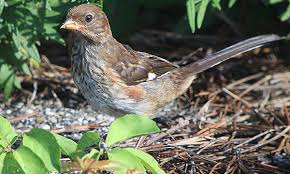
SGG is a bird nursery right now. After looking and listening to the House Wren for a while, I saw a bird on the ground near the flag poles. I did not recognize its markings right away, but its size and behavior (scratching at the ground and hopping backwards) was that of an Eastern Towhee. I assumed that this bird must be a juvenile Towhee. I checked my bird guide and matched this bird with the juvenile picture in the guide. They matched!

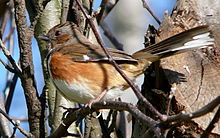
Juveniles of any bird species can be very difficult to identify. Just like fawns who have white spots for camouflage, juvenile birds look very different from their parents, even their mothers. This, of course, is for their protection. Notice the differences in the male, female, and juvenile Eastern Towhees in the following pictures. They all, however, have a small white patch on their upper wing.

Male Eastern Towhee

Male Eastern Towhee

Female Eastern Towhee

Female Eastern Towhee


Juvenile Eastern Towhee

Juvenile Eastern Towhee

I had guessed the identity of this juvenile based on its behavior, which is a good reminder to all birders that you must take into account visual and audio clues, behavior, and range when trying to ID birds. Light, as well as your binoculars, can play tricks with the coloration of birds.


As I continued on my walk, I spotted another juvenile. This time it was a Gray Catbird.

Juvenile Gray Catbird

Juvenile Gray Catbird


Juvenile Gray Catbirds look much like their parents except they appear fluffier. Like most juvenile birds, they are less wary of us. If I had approached an adult Gray Catbird as closely I had this juvenile, the adult would have quickly flown away. Usually, the juvenile’s parents are not far away and still are watching out for their offspring, so the juvenile is not completely defenseless.

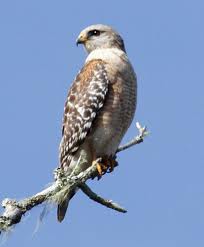
Another example of a juvenile bird’s immature behavior in regard to wariness occurred soon after I saw the Catbird. I was standing at the south end of the meadow looking at a male Brown Thrasher chase another male Brown Thrasher on the lawn when I heard a whooshing sound above my head. I looked up to see a juvenile Red-shouldered Hawk on a pine branch. He had a juicy caterpillar in his mouth and stared at me for a few seconds before proceeding to eat his breakfast.

Juvenile Red-shouldered Hawk

Juvenile Red-shouldered Hawk


A mature Red-Shouldered Hawk would not have chosen to perch so close to an animal (me) that might be a threat to it. This was something that juvenile hawk still had to learn. After the juvenile finished his caterpillar, he flew to another branch higher up in a nearby pine. The juvenile began to vocalize with that high, clear cry…keeyur keeyur. One of his parents quickly flew to him. I’m sure that juvenile got a quick reprimand about having landed so closely to me.

If you see a young bird on the ground, don’t assume it has been abandoned. Watch it for a while to see if a parent flies to it, or look up on branches to see if a parent is nearby.

There is so much fascinating drama going on all around us in nature. Go grab your binoculars and get a front row seat!

Happy Birding!

Thoughts on Gardens

“I hold the firm belief that the purpose of a garden is to give happiness and repose of mind.” — Gertrude Jekyll

I suspect Ms. Jekyll, a famous English gardener, had in mind those billowy, almost overblown cottage gardens when she made this comment.  While I am not aware of her travels, perhaps she had also seen those formal French parterres, defined by rigidly erect Italian cypress standing like sentinels guarding their lane.  Maybe she was also thinking of that contrived look popularized in the Victorian era with the long smooth lines of sheared hedges with topiaries as accents, intersecting each other in obtuse angles and perpendiculars; or those once highly favored knot gardens with their complex, wondrous geometry.  Possibly she preferred the raucous, disorganized appearance of the natural garden with its indeterminate splendor and cacophony of color.  Her options were just as horticulturally varied as they are today for the term ‘gardening’ encompasses many forms and preferences…formal or informal, exotic versus native, perennial, annual or combinations thereof; theme gardens of fragrance, colors, or textures, etc.

For me, I enjoy them all, particularly if I’m not the one to have to spend untold hours on shearing those amazing topiaries.  But now it’s spring and I can think of no prettier sight for my soul than a vegetable garden. In the suburban area where I live, that sort of gardening is at risk of becoming an archaic art. Most people when they mention they want to grow a few vegetables mean they are content with a four foot by four foot spot with the obligatory ‘Better Boy’ tomato plants.  While I don’t feel “old”, the fact is that I am a senior citizen and the whiteness on top of my head (aided by gravitational pull, no doubt) is gradually persuading the rest of my bodily hair to convert to its color.  Neither do I understand or get excited about the game of soccer and, admittedly, have had a somewhat awkward adjustment to the computer age. Recognizing these anachronistic characteristics is only reinforced by the fact that the only real vegetable gardens in my area seem to be cultivated by folks more ‘mature’ than myself.  The proximity and plentifulness of Kroger and Publix supermarkets in our region seems to displace the need for home grown produce.  The vegetable garden grown for sustenance and pleasure is increasingly infrequent here and only more readily seen in the countryside.

At our former home, we lived on six acres and I had a traditional “row crop” garden that was almost twelve thousand square feet in area.  I could never resist the urge to grow far more than our family of five could consume and I finally resorted to putting up a vegetable stand that had an honor system for payment.  Most summers produced a bounty of several hundred dollars in nickels, dimes, and quarters along with an occasional note of appreciation.

When we moved to our current residence, I read Mel Bartholomew’s book on Square Foot Gardening and became a convert to the raised bed method.  Clearing a growth of hardwoods by hand gave me a deeper sense of appreciation (along with calluses) for ancestors who did the same aided only by their back and any beast that was handy.  I now have ten beds each about eighty feet long and with a four foot interior width.  Raised beds have many advantages over the traditional row crop method, not the least of which is the efficient use of space and low soil compaction.

Most people who look at my garden promptly remark, “That looks like a lot of work!”  And while I understand their concern for effort, my activities there are not the type of toil that I associate with monetary compensation.   Rather, I get solace and comfort to which Gertrude Jekyll referred, particularly at this time of year. I have said and thought many times that I think there is nothing more beautiful than a vegetable garden at its peak.

In this part of the world June tends to be the optimum time for veggie gardens as most plants start to decline after they have accomplished their main purpose in life – which is to reproduce themselves (an unfortunate similarity occurs in humans).   In that climax of growth, I love to see squash with its rambunctious, tropical look; pole beans with lettuce slumbering below in leafy shade, clambering vigorously up the string trellis, searching for the sky with twisting runners.  Corn marches with military precision in straight rows three abreast, pumpkin and winter squash vines scrambling in irregular disarray at its feet.  Potato plants with their rich green foliage and bright purple flowers only hint at the buried treasure gripped by their roots.  English peas cascade down the metal fencing dripping their fruit in pale green, hard-to-see pods.  Okra, sweet potatoes, and black-eyed peas, young yet, eagerly await the hot July sun to fire their rampant growth.  Tomato plants bear hard green marbles of fruit, hopeful to become red, yellow, or pink softballs (sometimes chipmunks beat me to ‘em), and give off their wondrous distinctive odor when their foliage is brushed.   Cucumbers, peppers, cilantro, dill, garlic, and tomatilloes all claim their block of space in individual unordered groups as though they are on parade.

As always I try and pay attention to the need for crop rotation and planting companions.  Reminiscent of the way my grandmother gardened, I have interspersed sunflowers, zinnias, and nasturtium up front near the garden gate where they are most readily seen.  Around the perimeter of the raised beds are groups of red raspberries, blueberries, and, of course, strawberries, all poised to bear their progeny as the spring, and then summer, urge their fruit to ripen.  Fig trees, with their tree-like height, reside in an almost regal manner at the back of the garden as though positioned to keep watch over their domain.

And so it is the first of June, and I sit on one of the timbers that defines the edge of a raised bed.  It is early morning, and the sun is beginning to establish its presence at the west end of the garden, having barely eclipsed the roof line of our home.  I have just finished the first picking of one of the several dried bean varieties that I grow.  This particular one is called ‘Black Coco’ and I am shelling it so I can complete the drying process in my food dehydrator.  The legumes spill and roll into my container like fat and lazy, purple-black jelly beans.

My overall stillness encourages a nearby pair of Carolina wrens in search of insects, to explore the wire frames just a few feet away from me that support the tomato plants.  A dragonfly on patrol, cruises fiercely up and down the path between the raised beds.  Although the air is still and cool, an early cicada interrupts the morning quiet with his rising trill, announcing the beginning of what will be a hot day.  My garden cat, Tigger, has vacated his napping spot from under a huge crookneck squash leaf and prances about, tail furling and unfurling, waiting for my hand to be free so he can receive some attention.  Black bumblebees stumble groggily in their first erratic flights, seeking receptive blossoms while a lone Southern toad with careful solitary hops begins his search for a cool and secret site to spend the day.

I know the dark, crumbly soil is alive with toiling worms, patient grubs, and innumerable critters too small to be seen by the naked eye. I am surrounded by the quiet and unmistakable progress of living things, their growth not discernible but surely felt.  There is an almost indescribable feeling of serenity; a sense of peace that although seemingly brief, seeps into my subconscious to serve as a foundation for the rest of the day’s activities.  I’m confident Ms. Jekyll would agree this bountiful scene, in which I am privileged to participate, nourishes not only the physical body but also certainly “gives happiness and repose of mind”.


Bird Brained?

I am watching a friend while he drives his tractor and pulls a sixty- inch wide mower.  He is cutting his hay field of some forty acres.  Above, a midsummer sun coasts lazily through an azure sky as man and machine move noisily back and forth.  Sweet smelling grass lies in pleasing, uniform swathes and soothes the sounds and smoke from mowing.

At the same time, a gaggle of Purple Martins weave in tight, wildly erratic patterns about those implements.  Their numbers are hard to ascertain as their wheeling, diving yet graceful movements make them difficult to count.  At first glance, their wild maneuvering appears to be indicative of frustration with the tractor’s presence. These seemingly fearless fighter jets of the bird world swirl in individual patterns within inches of the machine and its operator, only to bank sharply and return for pass after pass.  Described by graceful silhouettes, their flights encompass every imaginable angle while staying within a few feet of the methodical tractor and its trailing mower.  Yet, their collective flying on dark- tipped wings never results in collisions or intimidations and my friend continues his work unimpeded.  It takes a few minutes for me to understand what these lovely, aerodynamic creatures are actually doing.

As the growling tractor makes its even cuts through the pasture, I notice that myriads of insects are rudely evicted from their respective hiding and feeding places.  Those not engulfed by the mower blades boil into helter-skelter flights with both alarm and escape on their minds.  Their explosive scattering occurs in every possible trajectory, a continual fireworks of six-legged frenzy.   In turn, the Martins are taking advantage of this easier- than- usual opportunity to feast upon the displaced insects.    Occasionally the birds take a break in proximity to the ongoing harvest, perching in a straight line on a telephone wire that crosses overhead.  Their rest periods are brief though, as they remain almost incessantly on the wing, swarming about the moving tractor and its offering.

By taking a slower pace, I am able to witness this symbiotic relationship between a human endeavor and Nature.  I am fortunate and these observations make me smile.   I think about a rather common insult, “bird brain” and I realize there should be some revisionist thought given to this derisive term.  ‘Bird brain’ should represent a sincere compliment.